Nashville Foot and Ankle Group: Board Certified Podiatric Physicians

Welcome to The Nashville Foot and Ankle Group. We look forward to becoming the sole foot care provider for you and your family. Call us and make an appointment today! A member of our courteous and smiling staff will be happy to assist you!

Our expert physicians specialize in comprehensive footcare for the entire family. If you need a foot doctor in the Nashville area, call one of our offices today! We provide treatment for the following conditions and many other foot problems. For more information, click on the links below:

Ingrown Toenails
(Permanent Correction)


Heel Pain / Spurs,
Bunions & Hammertoes


Warts / Skin Problems

Sprains & Fractures

Reconstructive Foot Surgery

Foot & Ankle Injuries

Diabetic Foot Care

Flat Feet / Fallen Arches

Corns & Calluses

Custom Orthotic Supports
We are a group of board certified Nashville podiatrists providing quality foot care for the entire family. Each member of the group has provided quality foot care for the greater Nashville area for over 20 years.

All four of our Nashville podiatrists are board certified by the ABPS, the highest level of board certification in the podiatry profession.

We are:

Dr. Berkeley Nicholls
Downtown Nashville
Hermitage | Smyrna


Dr. Steven Head
Southeast Nashville

Dr. Gary W. Cockrell
Brentwood/Franklin
North Nashville


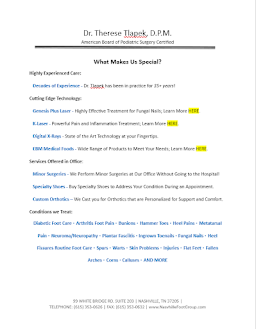
Dr. Therese Tlapek
West Nashville | St. Thomas
White Bridge Road
With seven locations across Nashville and Middle Tennessee, there is definitely a Nashville Foot and Ankle Group podiatrist near you! Let us help you get to your nearest foot doctor in Nashville by calling one of the locations below to get more information and easy directions from our friendly staff.

Downtown Nashville
615.321.3668

Hermitage
615.885.2339

Smyrna
615.459.5078

Southeast Nashville
615.333.2555

Brentwood/Franklin
615.370.8880

North Nashville
615.859.0502

West Nashville
615.353.0626


Featured Article:


Foot-Friendly Tips to Prevent Common Running Injuries

Keep Moving with Products Bearing the APMA's Seal of Acceptance
Bethesda, MD – Making running part of a workout routine leads to better physical stamina and a more positive state of mind—but a detrimental foot injury can quickly stop runners in their tracks. Keeping feet healthy and pain-free can go a long way toward ensuring that every run is enjoyable, for both experienced runners and those just starting out. Following a few simple steps provided by the American Podiatric Medical Association (APMA), before hitting the trail or treadmill, can keep foot and ankle injuries at bay.

"Some of the most common running-related foot injuries that today’s podiatrists treat are arch pain, tendonitis, and blisters," said APMA president Kathleen Stone, DPM. “However, if runners can take just a few minutes to stretch properly pre-workout, select appropriate footwear, and see a podiatrist immediately when foot pain occurs, many of these ailments can be avoided entirely.”
In order to get the most out of each run without falling victim to injury, APMA recommends the following:

Select a good running shoe: According to Karen Langone, DPM, president of the American Academy of Podiatric Sports Medicine (AAPSM), the most important running tip is proper shoe selection. “A running shoe purchase is dependent upon the type of foot and function of the foot for the individual. Runners should research shoe construction and keep in mind that footwear can vary in size from one manufacturer to the other,” she said.

APMA has recently given several running shoes its Seal of Acceptance for allowing proper foot function, including models made by Puma, Mizuno, Asics, Reebok, Avia, and Ryka. A sports medicine podiatrist can help aid in the footwear selection process if needed.

Select good socks: Runners should always fit shoes with the socks that they plan on wearing during a run. Socks should be made of a poly-cotton blend that pulls moisture from the skin, fit well, and be comfortable when worn with a running shoe.

Stretch out and build momentum: Before a run, begin by warming up and gently stretching for 5-10 minutes, focusing on lower leg muscles. Amateur runners should start with short distances, increasing distance over time to help prevent injury. All runners should begin every workout slowly, as this allows the body to warm up further and decreases the chance of muscle strain. Runners should also focus on keeping both the feet and entire body relaxed, avoid tensing or cramping toes, and run with a gait that feels the most natural. Cease running immediately if any pain is experienced.

Cool down and rest: After reaching the end of a running workout, cool down and stretch for about 10 minutes. Submerging the lower extremities in an ice bath after longer runs can reduce muscle soreness, as can the use of a self-massager designed for post-athletic activities (Health Enterprises Therapeutic Hot & Cold Foot Massager has the APMA’s Seal of Acceptance).

Muscle pain is common after exercise, and minor injuries may be treated with the RICE regimen (rest, ice, compression, elevation). However, if pain does not resolve itself after several days—or returns immediately upon resuming exercise—runners should seek out care from an APMA member podiatrist immediately.

Frequent runners should see a podiatrist on a regular basis to maximize any running program and prevent serious injury. For more on running and foot health, visit APMA’s new Runner’s Resource page at www.apma.org/runners.

For more information:
Mike Kulick
(301) 581-9220
mskulick@apma.org

"Like" APMA on Facebook: www.facebook.com/theAPMA
Follow us on Twitter: @APMAtweets

Founded in 1912, the American Podiatric Medical Association (APMA) is the nation's leading and recognized professional organization for doctors of podiatric medicine (DPMs). DPMs are podiatric physicians and surgeons, also known as podiatrists, qualified by their education, training and experience to diagnose and treat conditions affecting the foot, ankle and structures of the leg. The
medical education and training of a DPM includes four years of undergraduate education, four years of graduate education at an accredited podiatric medical college and two or three years of hospital residency training. APMA has 53 state component locations across the United States and its territories, with a membership of close to 12,000 podiatrists. All practicing APMA members are licensed by the state in which they practice podiatric medicine. For more information, visit www.apma.org.